2018-01-09 16:06:44 来源: chinadaily.com.cn
China's Belt and Road vision will be a route to a better world if the advantages and potential pitfalls are fully considered
"Time," wrote the Byzantine princess Anna Komnene nearly 900 years ago, "flies by irresistibly and perpetually, sweeping up and carrying with it everything that has seen the light of day - and plunges it into darkness."
2017 was that kind of year: one that flew past at a frightening pace. There were ups and there were downs. But in the future, historians will look back at the year just gone by as a time of continuity and of change, but above all one of transition.
The world is changing around us - regardless of which continent one happens to live on. In almost every case, the changes are for the better. We now live longer than ever before; the number pf people living in poverty is falling; literacy levels are rising. This should be a time of hope, a period of golden optimism for a future where the positive changes are consolidated and continue to allow for major improvements in the lives, not of millions, but of billions, of people on the planet.
There have been places riven by natural disasters - such as tropical storms in the Philippines and an Atlantic hurricane season that some suggest caused more than $200 billion in damage to Puerto Rico, Louisiana, Texas and Florida. There are the continued and rising problems of fragility and violence in Afghanistan, and a chronic humanitarian crisis in Yemen - where an estimated 50,000 children have died in the last 12 months from famine and disease.
But for most of us, 2017 was a year of good fortune, one crowned by increasing levels of prosperity, the continued rise of financial markets and a time of peace. We all have a great deal to look forward to.
And yet, almost everywhere one looks, it is fear, discord and anxiety that seem to be dominant. The United States and United Kingdom - states whose names alone talk of a single voice - are deeply divided. President Trump's leadership antagonizes one-half the population while galvanizing the other; Brexit is posing difficult questions about the fate and future of the European Union. Spain is at a crossroads, too, with many doubting whether the country will be able to withstand demands for Catalan independence in 2018. Then there is the rise of the far-right across many states that once would have proclaimed their final destination was to become liberal democracies.
The picture is no better elsewhere. The cancer of the Islamic State group may have been eradicated from Iraq and Syria, but few see the territorial losses as anything other than the end of a chapter, rather than the end of the story.
In these turbulent times, it has been more important than ever to talk about common bonds, about the importance of stability, about how working together achieves greater results than doing the opposite.
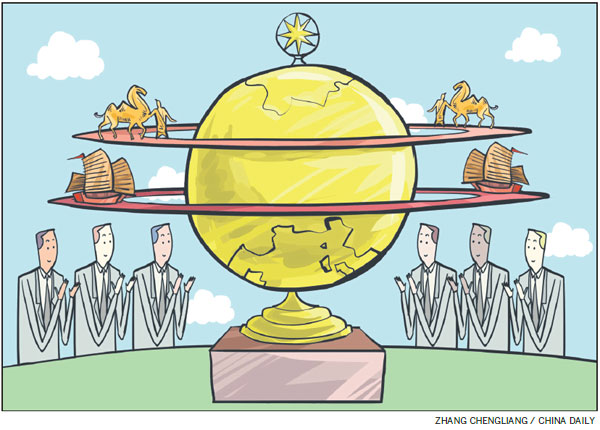
This was the theme of the Belt and Road forum that took place in Beijing in May. "We should foster a new type of international relations," President Xi Jinping said at the opening, "featuring win-win co-operation; and we should forge partnerships of dialogue with no confrontation and of friendship rather than alliance." It was a message of conciliation and mutual progress whose significance lay as much in the effort to foster unity as in its timing. The Belt and Road Initiative, Xi said during the forum, has a positive, progressive aim. "What we hope to create is a big family of harmonious co-existence," he said.
While it is hard not to embrace this message, it is also important to underline the difficulties in translating it into reality and into long-term results. Since the Belt and Road Initiative was first announced, in Astana, Kazakhstan, in 2013, nearly $1 trillion ($153.7 billion; 127.9 billion euros; £113.7 billion) has been invested or earmarked for investment in some 900 projects. Most involve massive upgrades to infrastructure, such as the building of roads and railways, but also pipelines, energy plants and both land and deepwater ports.
But investing in expensive, long-term projects such as these depends on regional stability and requires a steady nerve. The problem of balancing the aims of the Belt and Road Initiative is that there are risks in countries like Pakistan, Iran, Russia, across Central Asia - and now even Syria - where Chinese investment funds have been particularly active this year. All these countries along the ancient Silk Roads offer challenges of trying to establish what the short, as well as the long, term have in store. What that can - and often does - do in practice is to ratchet up the level of return that the investor requires for protection against dislocation, disturbance or, in the worst case, default.
One of the big questions for 2018 will be what happens when - not if - projects get into trouble. The Belt and Road Initiative, noted Xinhua in April last year, is "a Chinese solution to global economic blues". That could well be true, given the correct set of circumstances. There have been some dam-aging examples where things have not gone according to plan, and which have had a negative impact.
China needs to be sensitive to such cases and to carefully work through the local, regional and, indeed, wider, consequences. While it is important to keep telling the story of the benefits of cooperation, and to highlight the successful way that the Silk Roads of the past brought peoples together, allowed differences to be overlooked and encouraged the exchange of goods, ideas and much more, it is also crucial to anticipate problems and pre-empt them. China has already become a global superpower. Being a successful global superpower involves learning how to show the benefits of cooperation through the bad times as well as the good.
And that, in turn, means learning to adapt. Despite the great success of the Silk Roads in connecting cultures, peoples and states across the spine of Asia to link the Pacific with Central Asia, the Indian Ocean and the Mediterranean, the Chinese themselves were rather reluctant travelers and traders. Others came to China in search of products, ideas and sophistication and the Chinese often felt they did not need to do the same. Why head from the flourishing cities of coastal China or the interior across deserts and mountains?
In time, however, that mindset proved counterproductive to the point of being damaging, allowing Europe in particular to reap all the benefits and build its own global empires. One of the important lessons from the rise of the West lies in the way that scholars, merchants and politicians were encouraged to look beyond their own cultures and understand the wider world.
So education lies at the cornerstone of what will happen along the Silk Roads in 2018, and indeed beyond. As Confucius noted, wisdom can be acquired in one of three ways: "first, by reflection, which is noblest; second, by imitation, which is easiest; and third by experience, which is the bitterest".
And Confucius offered advice about this that was both natural and obvious: "Study the past if you would like to understand the future." The Silk Roads functioned and worked for a reason. Tolerance, openness and mutual respect were essential ingredients for enabling economic, but also cultural, technological and linguistic, exchange. Encouraging a wider view of the world is essential, in other words - and that starts in the classroom at an early age.
The Belt and Road Initiative, as President Xi said in May, is "the project of the century". 2018 will start to show a great deal more than how the Silk Roads are rising again; it will also tell us much about China itself - and how the world will be shaped in the coming decades. Time passes like an irresistible flood, wrote Anna Komnene in the 12th century. That makes seizing the moment all the more important.
