2018-03-26 17:45:35 来源: chinadaily.com.cn
Despite worldwide uncertainties and the shadow of protectionism, the prospects are bright for nation's economy
China's foreign trade recovered in 2017. It had reached a short-term peak in 2014, when the total value of imports and exports reached $4.3 trillion (3.5 trillion euros; £3 trillion), and then dropped over the next two years to $4 trillion in 2016. However, it increased by 14.2 percent in 2017, with imports up 18.7 percent and exports by 10.8 percent. This shows that imports increased very quickly.
Foreign trade in 2015 and 2016 was affected by the decrease of China's economic growth, the downturn of the global economy, the intensification of trade protection and the rise of "anti-globalization", while the recovery in 2017 was related to the recovery of international markets and the stable development of the domestic economy.
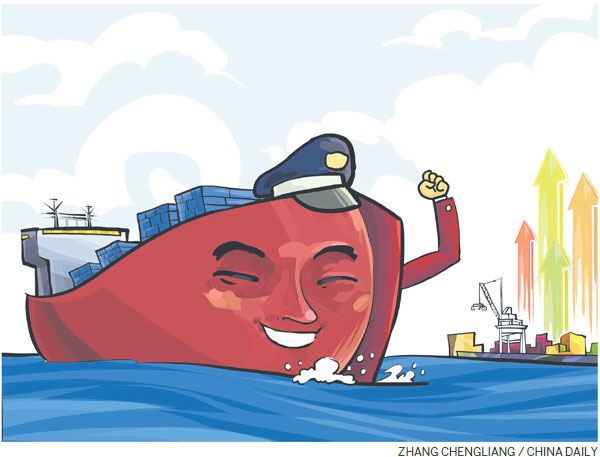
According to statistics released by the World Trade Organization, the world's major economies saw a total increase in trade of 10.7 percent in the first 10 months of 2017. At the same time, China's economy stabilized last year with an increase of 6.9 percent, or 0.2 percent higher than the previous year. The structure of foreign trade improved. Exports to BRICS and Belt and Road countries grew rapidly. In view of China's internal factors, the prospects for China's foreign trade are optimistic.
First, China's economic reform is an important factor. Supply-side reform, which started in 2015, is mainly aimed at the structural adjustment of Chinese manufacturing enterprises and, at the same time, it provides a strong guarantee for the quality of future export products. With optimized export commodities, it can be expected that the volume of China's exports will further increase.
Second, China's economy still has room to expand its foreign trade. The economy has three tiers. The economy of the first-tier cities is close to that of developed countries but production costs are too high for some industries, which means some industries will be moved to the second- or third-tier cities.
In terms of imports, the demand for low-end raw materials for first-tier cities has correspondingly decreased. However, such demand will increase in second- or third-tier cities and, meanwhile, the demand for high-end goods in first-tier cities is on the rise. For example, demand for spacecraft parts from countries in Europe and Americas is beginning to grow.
In terms of exports, the second and third tier cities in China will continue to export traditional Chinese products, while first-tier cities develop high-tech products. China, as a large exporter of electromechanical products, accounted for 12.1 percent of the total exports of items with high technical content and added value in 2017. From January to September last year, exports of machinery, electronic products and components to the EU and the United States£China's two largest export destinations£increased by 13.3 percent and 11.5 percent, respectively. It can be speculated that, with the continuous improvement of China's policies and technologies, the country's exports will grow steadily this year, with export products optimized and the export of high-quality, high-tech products increasing.
Finally, China's active construction of the Belt and Road Initiative's network will be a positive factor for international trade in the future. China has accumulated a large amount of technology, talent, experience and capital related to the industries of infrastructure construction. For the countries involved, China's low-cost loans and complete infrastructure programs will save a great deal of resources. These countries will find a vast market for their products in China and, at the same time, China will find channels for its excess production.
After several years of hard work, many infrastructure construction projects have been successfully taken to countries such as Pakistan, Indonesia and Iran.
There are, however, some uncertainties. First, the world economic recovery is not yet clearly underway. The Global Economic Outlook report released by the International Monetary Fund on Jan 23 says that the global economy recovered slowly in 2017. It is estimated that global output rose by 3.7 percent and economic growth in Asia and Europe was notable. However, long-term growth is still uncertain and there is the possibility of another decline.
Second, global trade protectionism is on the rise. In order to protect themselves and reduce their trade deficits, countries have introduced trade protection measures such as subsidizing their own export products and using tariff barriers. For example, the European Union issued a new anti-dumping regulations and said the Chinese market was seriously distorted at the end of last year.
Finally, it is possible that the growth rate of trade between China and the US will slow down. Since China's accession to the World Trade Organization, the quality of technical products exported from the country has been constantly improving, narrowing the gap with similar products from the US and other developed countries. In recent years, China has ranked first among the major sources of trade deficit in the United States, which is why the US has become cautious about China's export trade.
After taking office, US President Donald Trump quit the Paris climate agreement and vigorously defended the US manufacturing industry. Some of the products China exports to the US may be affected. From January to September last year, total imports of clothing and footwear products in the US decreased by 3.1 percent and 0.3 percent, respectively, compared with the same period last year, while China's exports of clothing and footwear products to the US from January to September last year decreased by 2.8 percent and 1.9 percent. In January, Trump initiated a trade remedy investigation on solar panels from China and raised the corresponding import tariffs.
To sum up, although there are still some uncertainties in outside environments, China's domestic factors will support a continuation of the recovery trend of 2017.
China's domestic supply-side reform and the international policy of the Belt and Road Initiative are making China an important stabilizing factor for foreign trade.
The author is a lecturer at the Management School of Shanghai University, and a research fellow at the China Europe International Business School Lujiazui International Finance Research Center. The views do not necessarily reflect those of China Daily.
