2020-03-06 10:59:57 来源: Xinhua
India is home to nearly 75 percent of the world's tiger population.
To protect the endangered tigers and other wild animals, India's central Madhya Pradesh state proposes to boost wildlife tourism, and combat the threats of climate change and global warming.
NEW DELHI, March 4 (Xinhua) -- As the World Wildlife Day falls on Tuesday, India's central state of Madhya Pradesh, better known as the "Heart of India," is aiming to boost tourism banking on its tigers.
The state remains home to the largest number of tigers, leopards, vultures in the country. Over the years the state has made relentless efforts to increase the population of the highly endangered "Barasingha," a hard ground swamp deer, and has come a long way in protecting the natural order and habitat for animals.
It also boasts the largest number of tigers, 526, out of the country's total headcount of 3,000 and continues to leave no stone unturned to ensure protection of wildlife. It also aims at protecting the rich diversity of wildlife species, ecosystems and ecosystem services.
India is home to nearly 75 percent of the world's tiger population. The country has committed to doubling the number of tigers in the next two years.
Also described as the "Wildlife State of India," Madhya Pradesh has as many as 11 national parks and 24 wildlife sanctuaries, besides six tiger reserves which are a part of national parks and wildlife sanctuaries.
Across India there are a total of 50 tiger reserves which are governed by Project Tiger, a dedicated programme for tiger conservation administered by the National Tiger Conservation Authority (NTCA).
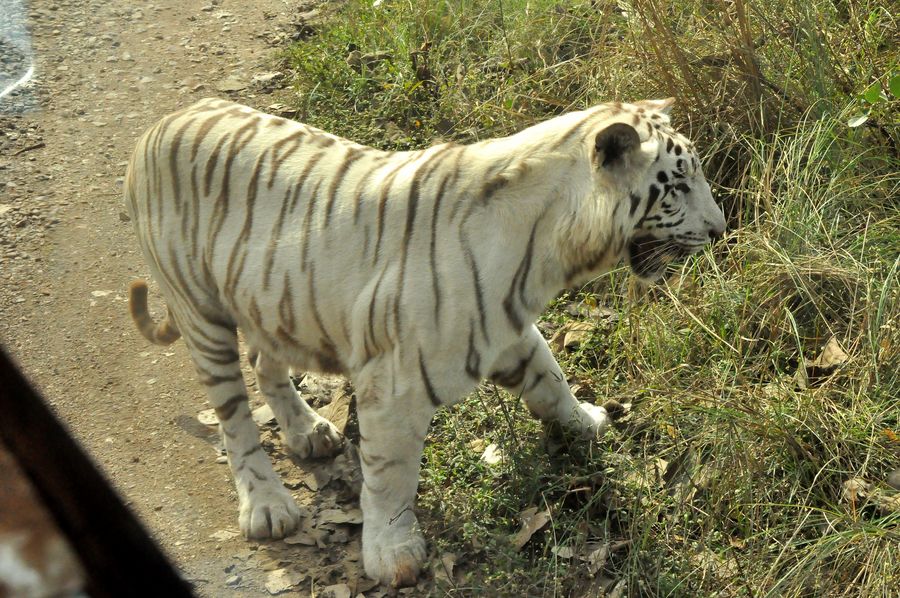
Photo taken on Feb. 29, 2020 shows a white tiger in a zoological park at Mukundpur in India's central state of Madhya Pradesh. (Xinhua/Stringer)
Hailing the state government's moves for wildlife conservation, Pushpraj Singh, an environmentalist and conservationist from the state's Rewa district, suggests that the state could attract a large number of tourists, both from home and abroad, if more focus was laid on promoting activities like white tiger safari such as the one at the Mukundpur White Tiger Safari and Zoo.
According to Singh, a former member of the country's Wildlife Board, Madhya Pradesh's tourism potential was still untapped, and that a few concrete steps like improving connectivity infrastructure could do wonders.
Over two decades ago he set up a trust for the protection of wildlife and environment, along with the welfare of the local tribesmen.
Madhya Pradesh Tourism Secretary Faiz Ahmed Kidwai said that on the occasion of the World Wildlife Day the state reiterates its focus on wildlife tourism, and combating threats of climate change and global warming through wild-life conservation.
"It focuses on creating favorable conditions for the conservation of tigers especially the endangered Bengal Tiger and the rare White Tiger. As the World Wildlife Day approaches on March 3, we would like to reiterate our commitment to protecting endangered wildlife, specially tigers through a scientific, planned and people-centric approach with strict enforcement guidelines and team support," he said.
About the idea of promoting white tiger safari, Kidwai said that within the state there were as many as nine white tigers, which remain a key attraction for tourists. "But these white tigers are not part of the tiger census as these are not in the wild, but in captivity," he added.
According to him, the first white tiger Mohan, considered as the forefather of all the white tigers, was found in Madhya Pradesh only. "We recently launched a new logo for Sanjay Tiger Reserve which bears the facial marks of Mohan with the characteristic blue eyes," he said.
White tigers are said to be a mutant variety of the yellow tiger. They have a gene which is the outcome of a mutation process and gives the yellow tiger a white color skin and blue eyes. The white tiger is not a different sub species, but very much a part of the Royal Bengal Tiger family.
